How much does virtual staging cost?
AI virtual staging costs about $1–15 per photo — far below traditional staging.
Want it done for you? Send us the photos.
AI-staged, then checked by a person before it reaches you. Walls, windows, floors and fixtures are never altered — if they are, we redo it free.
✓
Delivered within 24 hours
✓
One free revision per photo
✓
MLS “virtually staged” disclosure line included
✓
Not happy? Full refund
Prompt used
Copy
Virtually stage this empty living room as a warm, modern space for a real-estate listing. Add a light-gray fabric sofa, a wood coffee table, a soft rug, a floor lamp, some wall art, and one or two plants. Keep the room itself exactly as it is — same walls, windows, flooring, and proportions; only add furniture, do not repaint or change the architecture. Photorealistic, with lighting that matches the existing room.
No credit card required
Failed generations cost 0 credits
Credits never expire
Virtually stage this empty living room as a warm, modern space for a real-estate listing. Add a light-gray fabric sofa, a wood coffee table, a soft rug, a floor lamp, some wall art, and one or two plants. Keep the room itself exactly as it is — same walls, windows, flooring, and proportions; only add furniture, do not repaint or change the architecture. Photorealistic, with lighting that matches the existing room.

load_skill: virtual-staging
Skill: virtual-staging ▾
Now let me look at the room to understand its layout and lighting before staging it.
Let's break down this empty modern apartment room fully: ▾
Got it. Nice modern studio space with warm off-white walls, light oak floors, and a big centered sliding glass door bringing in natural light. I'll stage this with your warm modern furniture list.
The richer the detail, the more worth the wait...
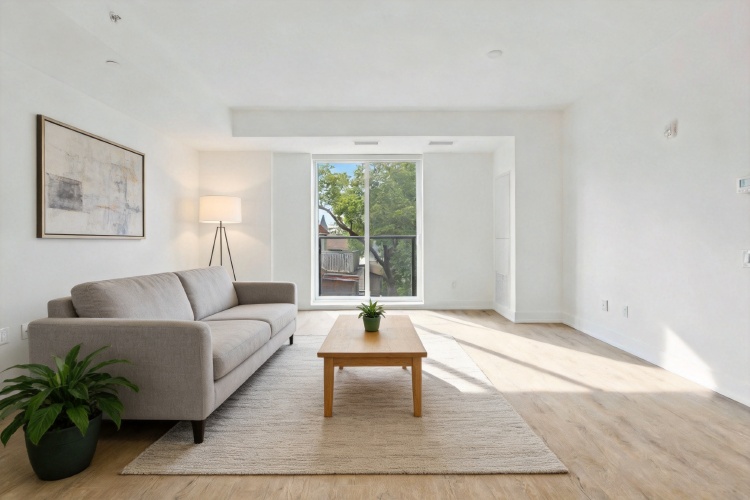
Here's your staged living room — I added the light-gray sofa facing the glass door, wood coffee table on a soft rug, a floor lamp, wall art, and a couple of plants. The room itself (walls, floors, that centered sliding door, ceiling fixtures) is untouched; only furniture and decor were added, with shadows matched to the daylight coming through the back.
For a real listing: MLS convention and several state rules require virtually staged photos to be labeled "virtually staged." I'd also recommend keeping the original empty shot alongside — buyers appreciate the transparency, and it keeps you clear of misrepresentation issues.
Want a different style variant (maybe Scandinavian or mid-century) to compare?
Virtual staging swaps the cost of moving real furniture into a home for software that furnishes the photo instead. The price gap is large, so it helps to see the three options side by side.
What each option costs
- Physical staging: renting furniture and styling a home typically starts around $1,500 and climbs with every room and every month it sits on the market.
- Professional virtual staging services: a human designer edits your photo for roughly $24–75 per image (median near $39 a room), usually a one- to two-day turnaround.
- AI virtual staging: the same empty-room-to-furnished result for about $1–15 per photo, in minutes rather than days.
Agents on forums like Reddit report real-world costs closer to $10–15 per photo once revisions are counted — still a tiny fraction of physical staging, which is why staged listings are cited as selling meaningfully faster.
Is virtual staging allowed?
It's legal, but not a free-for-all. MLS rules and most real-estate boards require you to disclose that a photo is virtually staged — you can't present an edited room as the real thing. Best practice is to label the image and keep a real, unfurnished photo in the set. The agent here furnishes the room without repainting walls, moving windows, or altering the architecture, so the space a buyer sees is the space that exists — only the furniture is added. That keeps the disclosure honest and the listing defensible.
How the room stays unchanged
A listing photo has to show the room that exists, so every staged result is checked before you see it:
- Measured, not eyeballed. The result is lined up with your original by matching hundreds of points in both photos. If the camera position or zoom changed, that attempt is rejected — an AI "looking" at the two images tends to call them the same when they aren't.
- Redone automatically. A rejected attempt is run again with the same instructions, up to three times; if all three drift, a second image model gets one more try. Each attempt uses credits.
- Doors, windows and fixtures checked one by one, side by side with the original.
- Told plainly. You're told what was re-run and why — and if nothing passes, you're told that instead of being handed a photo that doesn't match the house.
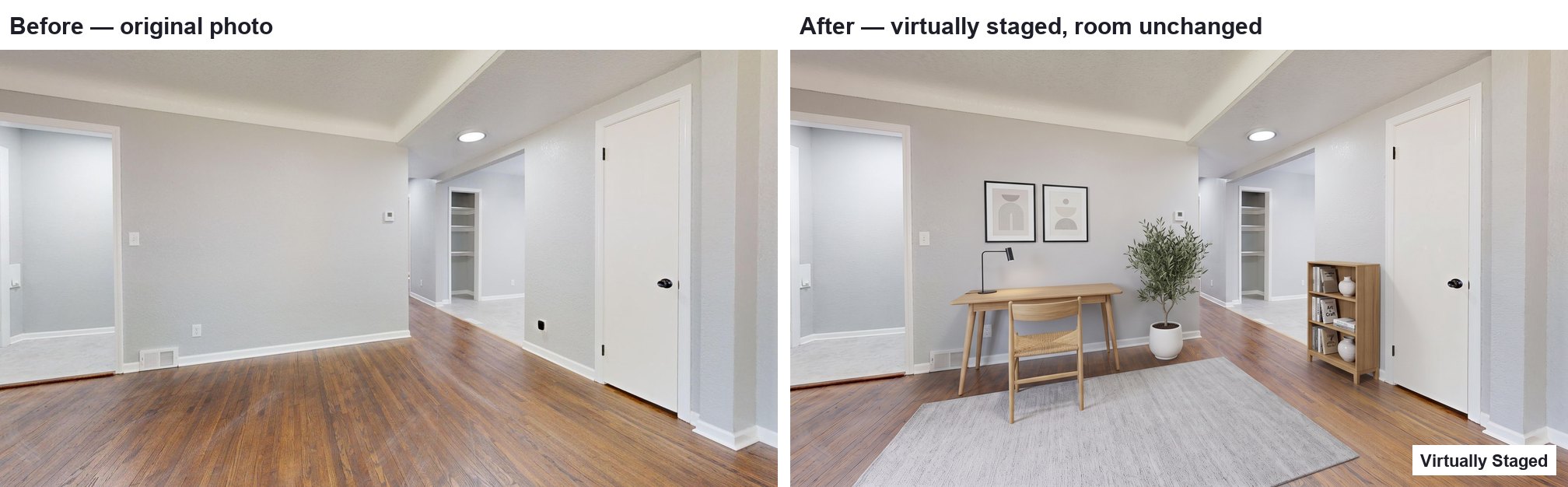
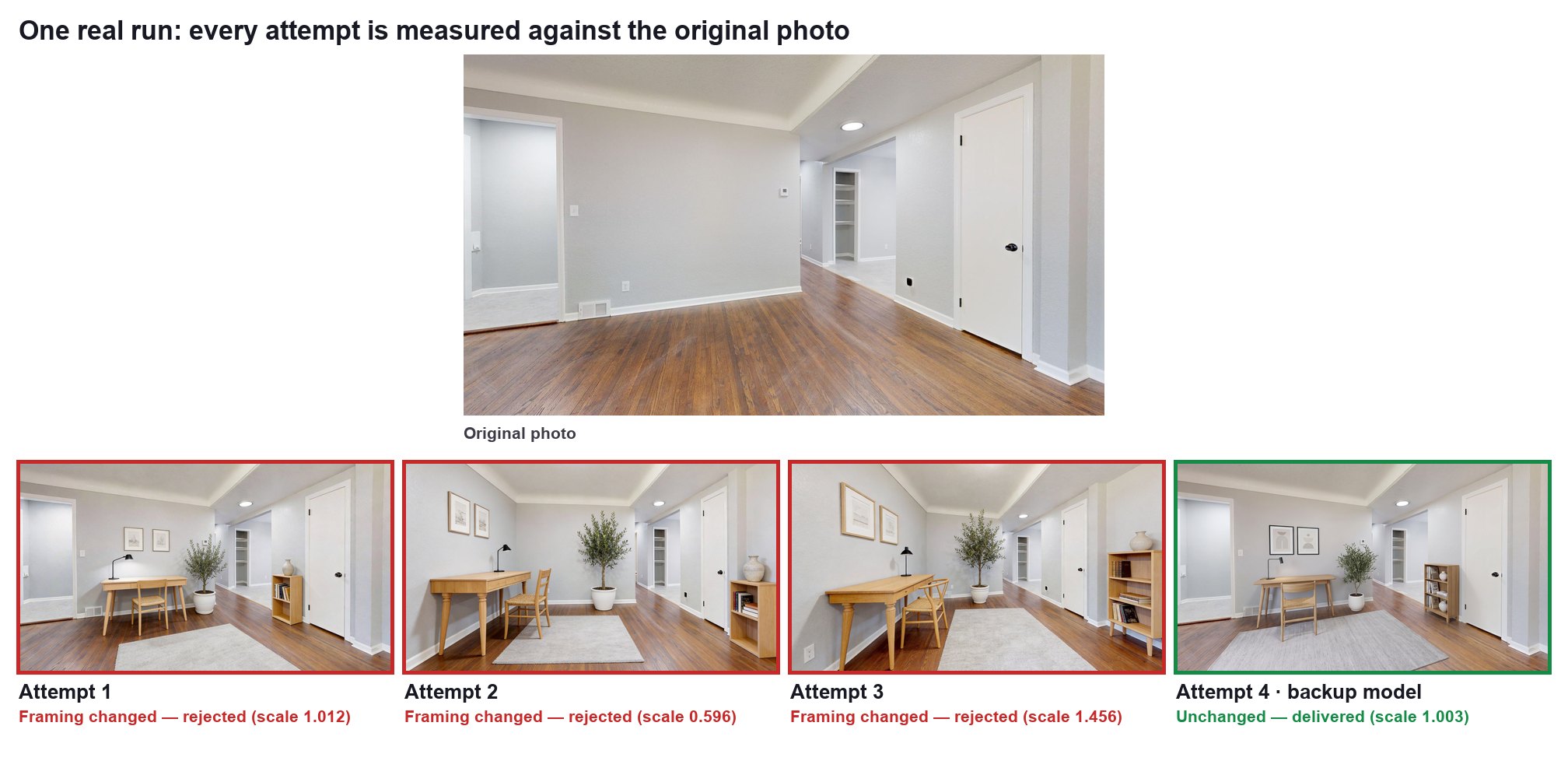
This room — two open doorways and a door — is the hardest kind for AI staging. In the run above, the first three attempts changed the framing and were rejected; the fourth kept the room exactly as photographed and was the one delivered.
Can ChatGPT do virtual staging?
A general chatbot can talk about staging, but it won't reliably furnish your actual photo while preserving the room. General image models tend to redraw the whole scene — different windows, warped walls — which is exactly what a listing can't have. Virtual staging needs a model told to keep the room fixed and add only furnishings, which is what this agent does.
Try it free on your own listing photo
Create an account and you get starter credits that don't expire — enough to stage a real photo and judge the result before paying. Upload an empty-room shot, describe the look ("warm mid-century living room, neutral tones"), and compare it against the bare room. No card, no subscription to start.
FAQ
Is virtual staging a good idea?
Yes, when it's disclosed. It helps buyers picture a space and is cited as helping homes sell faster, at a fraction of physical staging's cost. The one rule: label it as virtually staged and keep an unedited photo available.
How long does virtual staging take?
With AI, minutes per photo. Human virtual staging services usually take one to two business days per batch; physical staging takes days to schedule and set up.
Can you virtually stage a furnished house?
Yes, though it's more work — clutter and existing furniture may need removing first for a clean result. Empty or lightly furnished rooms give the cleanest output.
Do realtors use virtual staging?
Widely. It's a standard listing tool because it's cheap, fast, and — when disclosed — accepted by MLS. Many agents virtually stage every vacant listing.
No credit card required
Failed generations cost 0 credits
Credits never expire