How to do virtual staging with Nano Banana 2
Nano Banana 2 can furnish an empty room photo in about half a minute — the hard part is proving it didn't change the room.
Want it done for you? Send us the photos.
AI-staged, then checked by a person before it reaches you. Walls, windows, floors and fixtures are never altered — if they are, we redo it free.
✓
Delivered within 24 hours
✓
One free revision per photo
✓
MLS “virtually staged” disclosure line included
✓
Not happy? Full refund
Prompt used
Copy
Virtually stage this empty living room for a rental listing in a modern Scandinavian style, using Nano Banana 2 (the Gemini image model). One image, keep the room exactly as it is.
No credit card required
Failed generations cost 0 credits
Credits never expire
Virtually stage this empty living room for a rental listing in a modern Scandinavian style, using Nano Banana 2 (the Gemini image model). One image, keep the room exactly as it is: https://storm-agent.tos-cn-beijing.volces.com/f324eeb9-77f0-4055-a7a1-0f65e2455bc6/source/6298a99801e0666f.jpg

load_skill: virtual-staging, load_skill: vision
Skill: virtual-staging ▾
Skill: vision ▾
fewbox_remote_perception_perceive_images
Here is the complete list of fixed, unchangeable elements and details: ▾
fewbox_remote_vision_edit_image
The richer the detail, the more worth the wait...

fewbox_remote_perception_compare_framing
Framing vs the original: unchanged (scale 0.995, shift -0.0% / -0.3%, 512/534 matching features) — s… ▾
fewbox_remote_perception_perceive_images
Breakdown: ▾
Done — one staged image, modern Scandinavian, generated with the Gemini model (Nano Banana 2) as you asked.
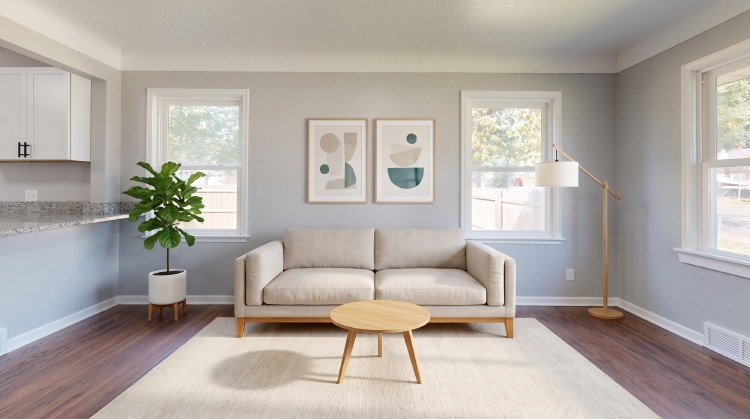
What went in: a light beige linen sofa with warm wood legs against the solid back wall between the two windows, a round light-oak coffee table, a cream area rug, two framed prints on the wall, a potted plant in the corner and a slim wooden floor lamp. Furniture shadows follow the light already in the photo — the light itself is untouched.
Checks: framing measured against your original — unchanged (scale 0.995, no shift), so the camera and composition match. Side-by-side spot-check of every fixed element (kitchen doorway and breakfast bar, all three windows, both outlets, floor register, baseboards, trim, hardwood floor) came back PASS — nothing moved, nothing added or removed.
One thing worth saying plainly: if this goes on an MLS or any listing site, label it "virtually staged" and keep the original empty shot alongside it. US MLS convention and several state rules require it, and it protects you from misrepresentation complaints.
Want a second style variant to compare — japandi or contemporary?
Nano Banana 2 is Google's image model (Gemini 3.1 Flash Image). Ask it to "stage this empty living room" and it will — but a listing photo has a stricter rule than a pretty picture: the room itself must stay exactly as it is. Same windows, same doorways, same camera position. Only the furniture is new.
What happened on this photo
The replay above is one real run, start to finish:
- Input: an empty living room, 1600×900, three windows, a kitchen doorway, outlets and a floor register.
- Output: a modern Scandinavian setup — sofa against the solid back wall, round oak coffee table, rug, prints, plant, floor lamp — at 2752×1536, the photo's own 16:9 shape. (The agent passes the photo's own aspect ratio to the model, so a landscape room comes back landscape rather than cropped to another shape.)
- Framing check: the result was compared with the original by feature matching — scale 0.995, no shift, 512 of 534 matching points: unchanged. This is measured, not eyeballed: a vision model asked "is it the same?" will happily say yes to a photo that was zoomed out.
- Fixed-element check: every window, the doorway, both outlets, the register, trim and flooring — all still there, same place, same size.
- Cost: 105.8 credits for the whole job (the image is 101, the rest is the conversation) — about $0.21.
We ran the same photo four times that day; the framing came back unchanged all four times. That is one photo, not a promise: any image model can re-frame a room, which is why every result is measured.
When to use Nano Banana 2 here
The default model costs about a third as much per image, so it goes first. On staging jobs it changes the framing fairly often — in our tests from about a quarter to half of runs, depending on the photo. When it does, the result is re-run with the same prompt, up to three times, and if all three drift, Nano Banana 2 gets one more try. You can also simply ask for it: "use Nano Banana 2".
Disclose it
MLS rules and most portals require a virtually staged photo to be labelled as such, with the real empty photo alongside. The agent reminds you every time — and because the room itself is left untouched, the disclosure stays honest.
Try it on your own photo
Sign up and you get 100 starter credits that don't expire — enough for about two stagings with the default model (~40 credits each). A Nano Banana 2 staging is about 106 credits, so it needs a top-up ($9.90 buys 5,000). Upload an empty-room photo, describe the look, and compare it with the original.
FAQ
Is Nano Banana good for virtual staging?
It produces convincing, well-lit furniture and, on our test photo, kept the room's framing and fixtures unchanged. Like any image model it can still alter a room, so measure the result against the original before you list it.
Can I just use Nano Banana in the Gemini app?
You can prompt it yourself. What you won't get is the check: whether the camera moved, whether a window grew or a doorway disappeared. That check — and re-running when it fails — is the part that makes a staged photo safe to list.
How much does Nano Banana virtual staging cost?
Google lists Nano Banana 2 at $0.101 per 2K image. Here one staged photo came to 105.8 credits in total, about $0.21, including the conversation.
Does it change the room?
Not on the photo shown here — measured unchanged in four runs out of four. It can on other photos, which is why each result is compared with the original and re-run if the framing moved.
Do I have to disclose AI staging?
Yes. Label the photo "virtually staged" and keep the original empty photo in the listing.
No credit card required
Failed generations cost 0 credits
Credits never expire